Proudly serving Phoenix, Scottsdale, Glendale, Peoria, Paradise Valley, Tempe & surrounding areasCall or Text 24/7: 480-264-8603
Aerial drone view of a suburban neighborhood and desert landscape with Saguaro cacti in Phoenix, AZ.

EV Charger Installation & Dedicated 240V Circuit Wiring in Phoenix, AZ

Phoenix Electrician Co. installs EV chargers for homes and businesses in Phoenix, Scottsdale, Tempe, Mesa, Chandler, Glendale, and the greater Phoenix metro area. We provide Level 2 charger installation, dedicated 240V circuits, and electrical panel upgrades when existing capacity is not enough. Our broader electrical work includes repair and troubleshooting, outlet and switch installation, lighting, ceiling fans, circuit breakers, commercial service, and whole-home rewiring. Each charging project is planned around the property, vehicle, and selected equipment.

Many Phoenix houses built before the 2000s were not wired for a 40 to 50 amp charging load alongside a swamp cooler, pool pump, and two central AC units on 110-degree summer afternoons. We begin with a load calculation under National Electrical Code Article 220 and follow the EV equipment requirements in NEC Article 625. Our technicians are licensed through the Arizona Registrar of Contractors and pull permits through the municipal building department for the installation address. That planning helps match the circuit, conductor, breaker, and charger to the home's actual electrical capacity.

We install Tesla Wall Connectors, Wallbox, JuiceBox, ClipperCreek, and Eaton units with dedicated circuits, GFCI protection, proper grounding and bonding, and conduit suited to Phoenix conditions. Request a free quote before buying a charger so its amperage, plug type, and mounting location can be checked against your electrical system.

Phoenix Electrician Co. provides EV charger installation in Phoenix and throughout Scottsdale, Tempe, Mesa, Chandler, Glendale, and the greater Phoenix metro area.

★ ★ ★ ★ ★4.9/5 Average Rating · 20+ Years of Experience · Thousands of Customers Helped · Licensed & Insured · Residential & Commercial

Level 2 Charging Options & Benefits

What Is Level 2 EV Charging?

Level 1 charging uses a standard 120V outlet and adds roughly 3-5 miles of range per hour. Level 2 charging uses a 240V circuit and typically adds 20-40 miles of range per hour, depending on the vehicle and charger amperage. That faster rate makes Level 2 the practical home-charging choice for many Phoenix commuters.

A Level 2 installation needs a dedicated 240V circuit and a breaker sized at 125 percent of the charger's continuous load under NEC 210.19. Many residential units use a 40 or 50 amp breaker with 8 or 6 AWG copper conductor, while longer runs may require upsizing to address voltage drop.

A 48 amp Level 2 charger can replenish most EV batteries overnight, an important benefit for drivers crossing a 517.9-square-mile city. Home charging during off-peak hours under Salt River Project or Arizona Public Service time-of-use plans can also reduce the electricity cost of daily driving.

Benefits of Home EV Charging

A properly planned home charger makes daily charging more convenient while giving the circuit and equipment a dedicated, code-compliant electrical path. The installation can be tailored to the vehicle, parking location, panel capacity, and preferred plug-in or hardwired setup.

  • Adds approximately 20-40 miles of range per hour with Level 2 charging
  • Supports overnight charging with many 48 amp home units
  • Makes off-peak utility charging easier to schedule
  • Uses a dedicated 240V circuit sized for the charger
  • Allows hardwired or manufacturer-approved plug-in configurations
  • Includes proper grounding, bonding, and required GFCI protection
  • Works with garage, driveway, exterior-wall, and detached-garage layouts
  • Provides permitted, inspected documentation for new circuit and panel work
EV Charging Services

Phoenix EV Charger Services

From straightforward Level 2 circuits to panel upgrades and weatherproof exterior installations, each service starts with the charger's specifications and the property's available electrical capacity. We plan conductor size, breaker rating, route, mounting location, grounding, and permit requirements as one coordinated project.

Level 2 Charger Installation

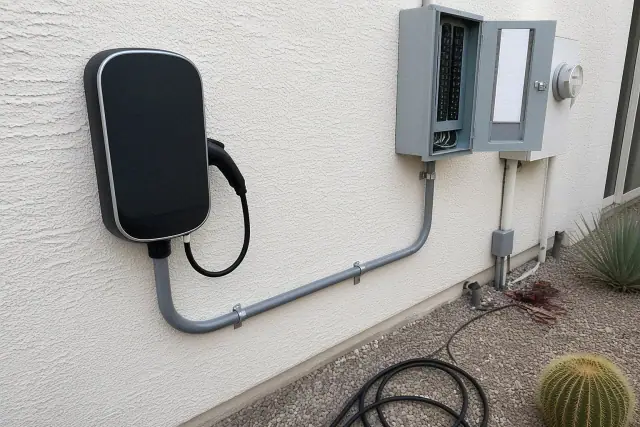
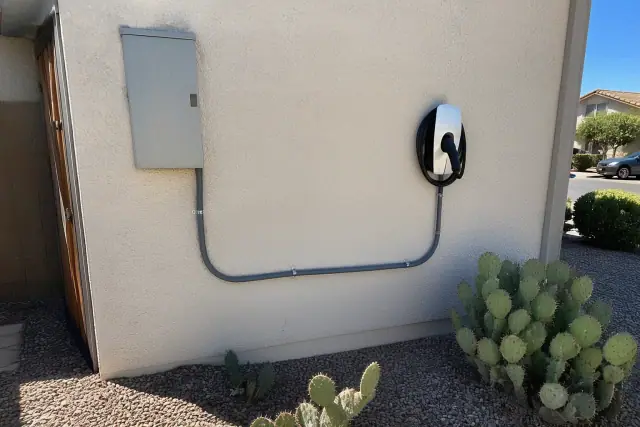
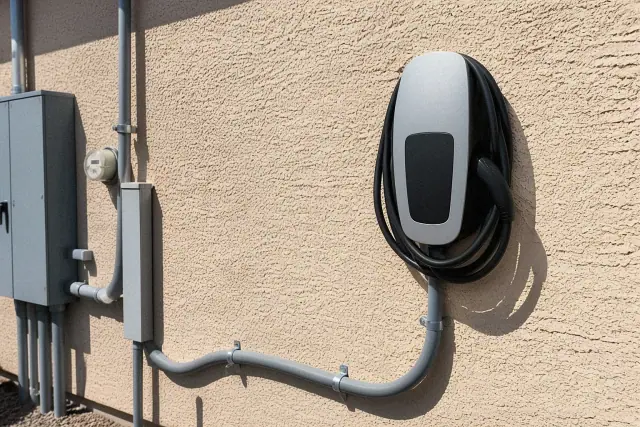
A Level 2 EV charger mounted on a stucco wall with conduit piping at a jobsite in Phoenix, AZ.

We install plug-in and hardwired Level 2 charging equipment on dedicated 240V circuits. Breaker size, conductor gauge, run length, grounding, bonding, and GFCI protection are matched to the charger's continuous load and manufacturer instructions.

Request Estimate

240V EV Charging Outlets

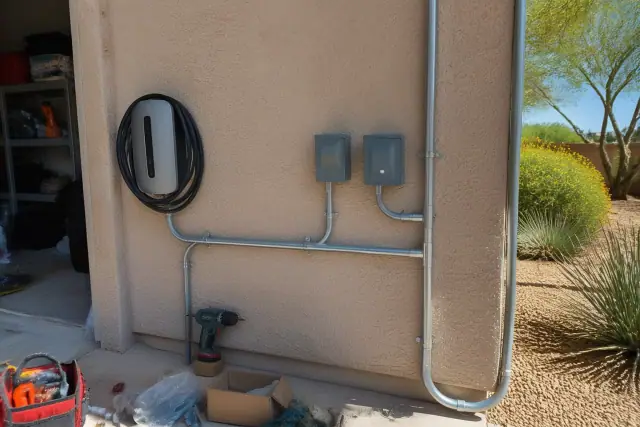
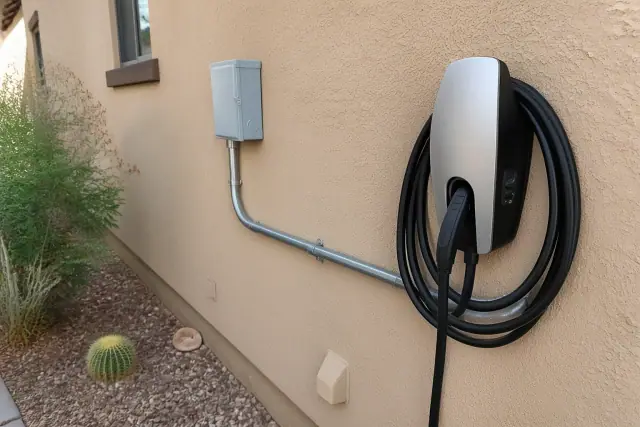
Wall-mounted 240V EV charging unit with conduit piping at a job site in Phoenix, AZ.

For compatible plug-in chargers, we install NEMA 14-50 or NEMA 6-50 outlets according to the equipment specification. The outlet receives a dedicated circuit, correctly matched breaker, proper grounding, and a weatherproof cover when mounted outside.

Request Estimate

Tesla & Universal Charger Setup

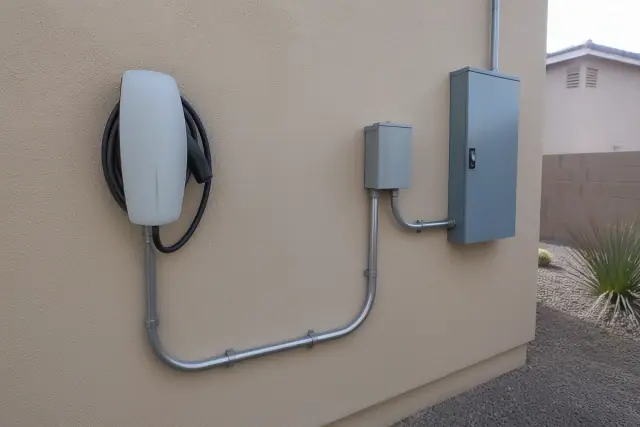
EV charger installed on a stucco home wall with conduit piping in Phoenix, AZ.

Installation is available for Tesla Wall Connectors as well as Wallbox, JuiceBox, ClipperCreek, and Eaton units. We confirm the vehicle's charge-port location, the charger's amperage and connection type, and a practical mounting position before work begins.

Request Estimate

Electrical Panel Upgrades

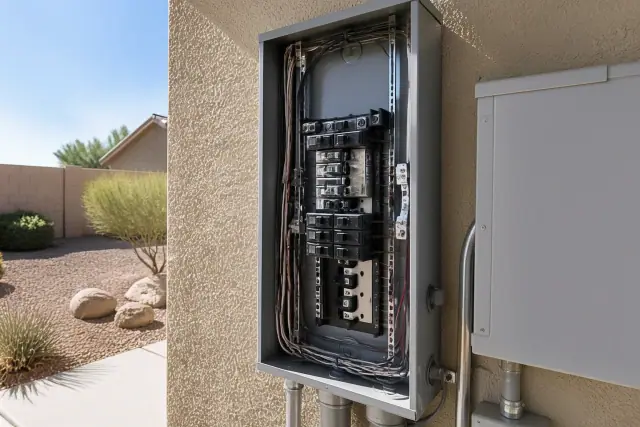
Electrician installing a circuit breaker for an EV charger in a Phoenix, AZ residential electrical panel.

Phoenix homes from the 1970s and 80s may still have 100 amp panels already carrying HVAC and pool loads. When the load calculation shows insufficient headroom, the project may include a 150 or 200 amp service upgrade or a subpanel dedicated to the charging circuit.

Request Estimate

Outdoor & Detached-Garage Installation

EV charger installed on a stucco wall with conduit piping at a home in Phoenix, AZ.

Exterior walls, driveways, and detached garages require careful route and equipment planning. We account for trenching, Phoenix caliche soil, UV-resistant conduit and fittings, outdoor-rated enclosures, and ambient-temperature corrections for conductors exposed to direct sun or attic heat.

Request Estimate

Commercial EV Charging Installation

EV charger mounted on a stucco wall with conduit piping at a jobsite in Phoenix, AZ.

Phoenix Electrician Co. also installs EV charging equipment for business properties. Planning covers available service capacity, charger location, conduit distance, mounting conditions, dedicated-circuit requirements, and the permit and inspection process.

Request Estimate
Charging Installation Options

EV Charger Installation Options

The right configuration depends on the charger model, parking position, panel location, weather exposure, and whether flexibility or a permanent connection matters most. These five common approaches cover most residential charging layouts described in the site assessment.

Wall-mounted EV charger installation on a stucco wall with conduit piping at a home in Phoenix, AZ.

Hardwired Wall-Mounted Chargers

A hardwired wall-mounted charger eliminates the receptacle-and-plug connection point and creates a clean, permanent installation. Some manufacturers allow higher continuous amperage when their equipment is hardwired.

  • Dedicated 240V charging circuit
  • Direct connection without a receptacle
  • Terminal connections tightened to manufacturer torque specifications
  • Mounting placed near the vehicle charge port
  • Breaker and conductors matched to continuous load
Request Estimate
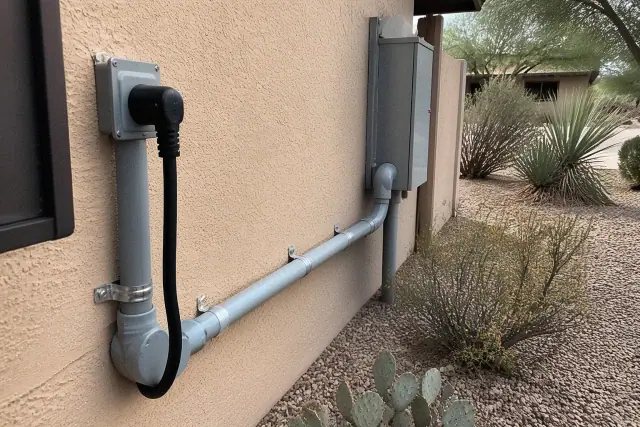
Wall-mounted EV charger with NEMA 14-50 plug and conduit installed at a home in Phoenix, AZ.

NEMA 14-50 Plug-In Charging

NEMA 14-50 is the most widely used outlet type for plug-in Level 2 charging and is compatible with many universal chargers and Tesla Mobile Connectors. It can also serve as an RV outlet when the connected equipment and circuit are compatible.

  • Matched 50 amp breaker
  • Dedicated circuit for continuous EV charging
  • Correct grounding and conductor sizing
  • Weatherproof cover for exterior locations
  • Compatibility verified before installation
Request Estimate
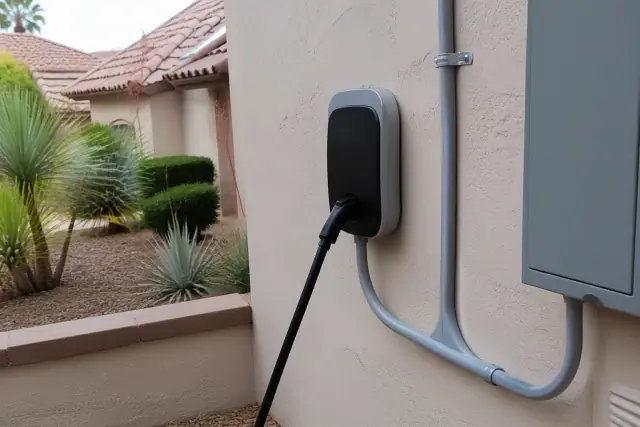
EV charger with NEMA 6-50 plug and conduit piping installed on a stucco wall in Phoenix, AZ.

NEMA 6-50 Plug-In Charging

Some charger manufacturers specify a NEMA 6-50 outlet, which does not use a neutral conductor and is wired differently from a NEMA 14-50. Confirming the charger specification prevents an incompatible outlet from being installed.

  • Outlet type matched to the charger model
  • No neutral conductor in the NEMA 6-50 configuration
  • Dedicated breaker sized for the equipment
  • Wire gauge adjusted for amperage and run length
  • Connection checked against manufacturer requirements
Request Estimate
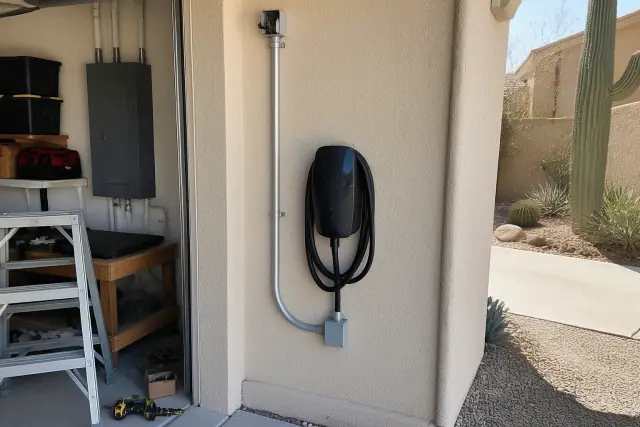
Technician installing an EV charger on a residential garage wall with conduit piping in Phoenix, AZ.

Garage & Indoor Charger Installation

Garage installations are common in Ahwatukee, Arcadia, and Desert Ridge because the equipment is shaded and the panel may be close to the parking position. Indoor placement still needs comfortable cord reach, bumper clearance, and compliance with manufacturer requirements near gas appliances.

  • Mounting aligned with the vehicle charge-port side
  • Conduit routed neatly along garage framing
  • Charge cord kept within comfortable reach
  • Clearance maintained from the vehicle bumper
  • Ventilation and equipment-spacing requirements checked
Request Estimate
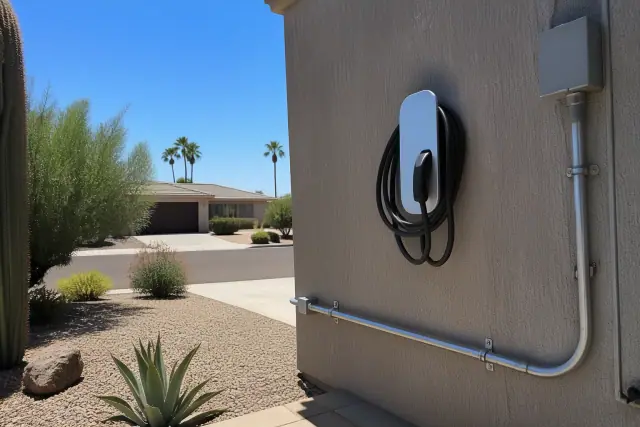
EV charger installed on a concrete wall with metal conduit piping in a xeriscaped yard in Phoenix, AZ.

Outdoor & Detached-Garage Charging

Outdoor and detached-garage installations need materials selected for Phoenix heat, direct sun, monsoon moisture, and blowing dust. Underground routes may also require more labor where caliche hardpan affects trenching.

  • Weatherproof, UL-rated charger enclosure
  • UV-resistant conduit and fittings
  • Ambient-temperature correction for exposed conductors
  • Dust and moisture protection for outdoor equipment
  • Voltage-drop review for long detached-garage runs
Request Estimate
Finding the Right Fit

Choosing the Right EV Charging Approach

Choosing between a hardwired charger, a NEMA outlet, an indoor mount, or an outdoor run starts with the site assessment. Panel headroom, route length, voltage drop, weather exposure, vehicle charge-port position, and charger specifications all shape the recommendation.

Load-Calculated Circuit Design

Every project starts with an NEC Article 220 load calculation rather than an assumption about spare breaker spaces. That calculation determines whether the existing panel can support the charger and guides circuit and conductor sizing.

Permit and Inspection Handling

New charging circuits and associated panel work require the correct municipal electrical permit and a final inspection. We handle the application and inspection scheduling for the installation address.

Charger-Compatible Installation

The charger's amperage, plug type, mounting instructions, clearances, and terminal torque specifications are checked before installation. This keeps the electrical work aligned with both NEC requirements and the selected equipment.

What Sets Us Apart

Why Choose Us for EV Charger Installation?

Phoenix Electrician Co. combines Arizona Registrar of Contractors licensing with load-calculated design, manufacturer-compatible installation, and municipal permit coordination. You receive a written estimate after the site assessment, and the circuit is tested for grounding and bonding continuity before closeout.

Get a Free Quote

Insufficient Panel Capacity

An open breaker space does not prove that a panel can carry another continuous load. A panel already serving dual HVAC equipment, a pool pump, and other major appliances may need an upgrade or dedicated subpanel before EV charging is added.

Incorrect Breaker and Wire Sizing

A breaker, conductor, or outlet that is too small for the charger's continuous draw can overheat or trip repeatedly. Sizing must account for the 125 percent continuous-load rule, conductor gauge, run length, and temperature conditions.

Shared or Unverified 240V Circuits

EV charging equipment needs a dedicated circuit rather than one shared with other outlets or appliances. Existing dryer, range, or RV receptacles should be checked for rating, wire condition, grounding, and compatibility before daily charging.

Long Runs and Voltage Drop

A charger far from the main panel may need larger conductors to compensate for voltage drop. Detached garages and side-yard routes can also add conduit, trenching, and placement decisions to the project.

Heat, Dust, and Outdoor Exposure

Direct Phoenix sun, attic heat, monsoon moisture, and blowing dust can exceed the limits of indoor-only equipment or ordinary fittings. Outdoor work needs rated enclosures, UV-resistant materials, and temperature-aware conductor sizing.

Loose Connections and Overheating

Improperly torqued terminal connections are a common source of overheating and nuisance tripping during charger troubleshooting. Correct torque, grounding and bonding checks, and compatibility with the specified outlet help reduce those failures.

How It Works

Our EV Charger Installation Process

The process moves from capacity and placement decisions to a permitted, tested installation. Each step is tied to the charger model, the property's electrical system, and the local building department responsible for inspection.

01.

On-Site Assessment

We inspect the panel, measure the route to the charging location, review garage, driveway, or exterior-wall placement, and confirm where the vehicle's charge port will sit.

02.

Load Calculation and Panel Review

We calculate existing and proposed loads under NEC Article 220, then determine whether the panel has adequate headroom or needs a service upgrade or subpanel.

03.

Charger and Circuit Planning

The charger model, amperage, hardwired or plug-in connection, breaker, wire gauge, conduit route, weather exposure, and voltage drop are planned together.

04.

Written Estimate and Permit

After the assessment, we provide a written estimate covering the installation scope. We then submit the required electrical permit through the building department serving the address.

05.

Circuit and Charger Installation

We install the dedicated circuit, grounding, bonding, required GFCI protection, outlet or hardwired connection, and charger mount. A straightforward project with adequate panel capacity typically takes 3-5 hours in one visit.

06.

Testing and Final Inspection

Grounding and bonding continuity, terminal connections, and charger operation are checked before closeout. Projects involving panel upgrades, trenching, or inspection scheduling usually span 2-4 business days from start through final sign-off.

Plan Your Home Charging

Schedule an EV Charger
Consultation

Request a free EV charger installation quote in Phoenix, Scottsdale, Tempe, or Mesa. We will review your panel, parking layout, vehicle, and charger specifications so the written estimate reflects the actual circuit and installation conditions.

EV Charging Help

EV Charger Installation FAQs

These answers cover Phoenix EV charger costs, electrical requirements, permits, timelines, equipment choices, and common installation decisions. A site assessment is still necessary to match the answer to your panel, layout, and charger.

Call About EV Charging

For a typical Phoenix home installing a single Level 2 charger, most projects fall between $800 and $3,000 including labor, materials, and permit fees. Charger hardware is separate and usually costs $400-$700, depending on brand and amperage. A written quote follows the panel and garage assessment.

A basic 240V outlet close to a panel with enough spare capacity commonly costs $650-$1,800. Panel upgrades, long conduit runs, driveway trenching, or permit and inspection needs can move the total into the $2,500-$4,500 range.

Internal Revenue Code Section 30C may cover 30 percent of equipment and installation costs up to $1,000 for a qualifying residential installation. Eligibility depends on whether the address is in a qualifying census tract. Confirm current eligibility and filing requirements with a tax professional, and check current Salt River Project or Arizona Public Service incentive availability separately.

An existing NEMA 14-50 or other 240V outlet may work only when its type, circuit rating, and condition match the charger's manufacturer specifications. The receptacle should be on a dedicated circuit with the correct breaker, conductors, and grounding. A dryer or range outlet may not have been designed for continuous daily EV charging.

The installation needs a dedicated circuit, a breaker sized to the charger's continuous load, correctly gauged conductors for the amperage and run length, grounding and bonding, and GFCI protection where required. NEC Article 625 covers EV charging equipment, while the load calculation helps determine whether the existing service can support it.

A straightforward installation with adequate panel capacity typically takes 3-5 hours in a single visit. Work requiring a panel upgrade, trenching, a longer conduit route, or permit inspection scheduling usually takes 2-4 business days from the initial visit through final sign-off.

Yes. The City of Phoenix Development Services Department requires an electrical permit for a new charging circuit and related panel work, followed by a final municipal inspection. Phoenix Electrician Co. handles the permit application and inspection scheduling for the installation.

Breaker size depends on the charger's continuous amperage rating. Many residential units use a 40 or 50 amp dedicated breaker calculated at 125 percent of the rated draw under NEC 210.19, with 8 AWG copper commonly used for 40 amp circuits and 6 AWG copper for 50 amp circuits. Run length and ambient temperature can require adjustments.

Level 1 uses a standard 120V outlet and adds roughly 3-5 miles of range per hour. Level 2 uses a 240V circuit and adds approximately 20-40 miles per hour, depending on the vehicle and charger amperage. That difference is why Level 2 is the usual choice for overnight home charging.

A hardwired charger creates a permanent connection and removes the plug-and-receptacle point, while some manufacturers also allow higher continuous amperage when hardwired. A plug-in NEMA outlet provides more flexibility to change compatible equipment. The charger specifications, desired amperage, and location should guide the choice.

A panel upgrade is needed only when the load calculation shows that the existing service lacks capacity for the new continuous load. Some Phoenix homes with 100 amp panels may require a 150 or 200 amp service upgrade or a dedicated subpanel, especially when HVAC and pool equipment already use much of the available capacity.

Phoenix Electrician Co. installs Tesla Wall Connectors, Wallbox, JuiceBox, ClipperCreek, and Eaton charging equipment. Before installation, the model's amperage, connection type, clearances, terminal specifications, and outdoor rating are checked against the proposed circuit and location.

Both can support compatible plug-in Level 2 chargers, but they are wired differently. A NEMA 14-50 includes a neutral conductor and commonly uses a matched 50 amp breaker, while a NEMA 6-50 does not use a neutral. The outlet must match the charger manufacturer's specification.