Typical Hourly Rate
Expect $75-$125 per hour for standard residential work during business hours. A broader Phoenix metro range for licensed residential work is $85-$150 per hour, depending on scope and timing.
Phoenix Electrician Co. explains that Arizona electricians typically charge $50-$150 per hour, while most residential jobs we quote fall in the $75-$125 range. The final price changes with licensing level, job complexity, urgency, minimum billing, trip fees, materials, and permits, so the hourly number alone may not show the total cost.
Expect $75-$125 per hour for standard residential work during business hours. A broader Phoenix metro range for licensed residential work is $85-$150 per hour, depending on scope and timing.
Time of day, job complexity, property type, wiring access and age, permit requirements, and urgency all affect the rate. A simple outlet swap is priced differently from panel work or whole-home rewiring.
Ask whether the trip fee is credited toward the repair and whether labor, materials, permits, markup, and disposal are itemized. A written estimate makes an hourly or flat-rate quote easier to compare.
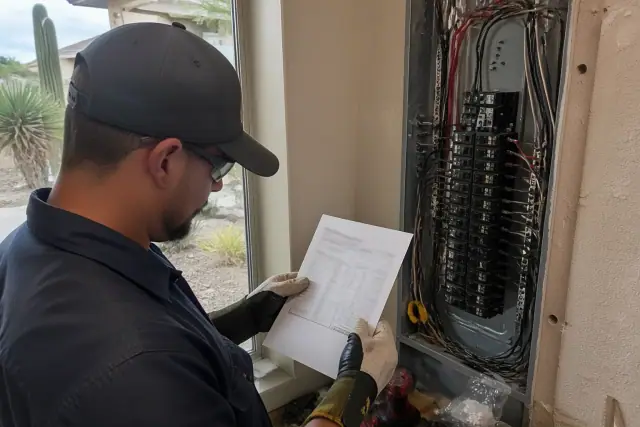
Labor, trip charges, materials, and permit costs as separate line items. This helps a homeowner see what the hourly rate includes before approving work.
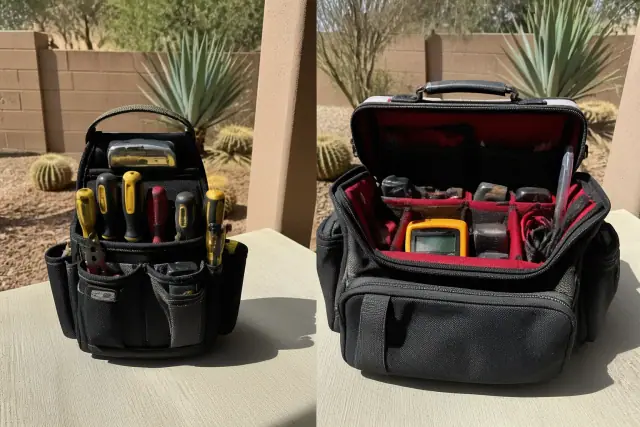
Contrast a scheduled daytime visit with a night, weekend, or holiday dispatch. The comparison should make the after-hours premium and minimum charge easy to understand.
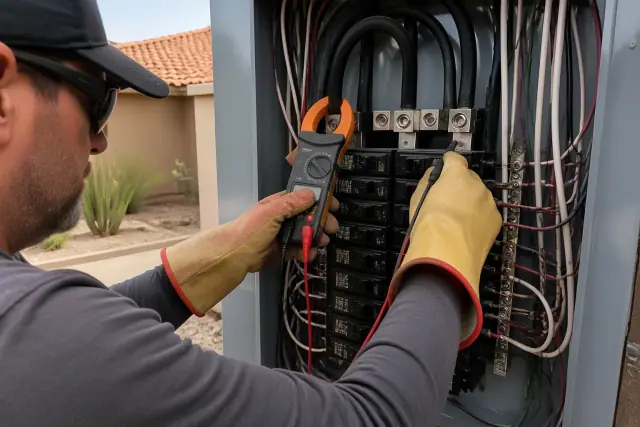
An electrician checking panel capacity and the planned wire run before pricing an EV charger installation. Those details explain why defined projects are often quoted at a flat rate.
Standard residential electrical work during business hours commonly falls in the $75-$125 per-hour range. Straightforward residential jobs may run $50-$100, while panel-related work can reach $125-$150 per hour.
A service call or trip charge typically runs $75-$150 before labor begins and may be credited toward the repair. Some Phoenix companies use a flat dispatch fee of about $85, so confirm how it applies.
Emergency or after-hours dispatch often runs $100-$175 per hour, while urgent or two-technician jobs can reach $175-$300. From July through September, monsoon-related outage and surge calls can increase demand in Phoenix.
EV charger installs, panel upgrades, and whole-home rewiring are often quoted as flat projects. An outlet repair may total $100-$200, while breaker troubleshooting commonly lands around $150-$300.
| Pricing Reference | Typical Range | How to Read It |
|---|---|---|
| Employee wage | $31-$48 per hour | Not the customer-facing billed rate |
| Arizona licensed contractor | $100-$125 per hour | A 2-3 hour minimum is common |
| Phoenix residential | $75-$95 per hour | The first hour may be priced higher |
| Commercial electrical work | $100-$200 per hour | Three-phase systems and scheduling can add cost |
| After-hours emergency | $150-$300 per hour | Urgent or two-technician work can reach the top end |
| Independent electrician | $48-$85 per hour | Confirm insurance and dispatch backup |
Additional benchmarks: National rates run $50-$150 per hour, with $65-$130 commonly cited. Arizona job postings report an average employee wage of $32.31 per hour plus roughly $9,438 in annual overtime.
An employee's hourly wage is not the same as a customer's billed rate. Licensed contractor pricing also covers bonding and liability insurance, tools, vehicle costs, permits, business licensing, and warranty support; those costs explain why a reported $32.31 employee wage is far below a $100-$125 contractor rate.
Time of day, complexity, property type, access, wiring age, permits, and urgency all affect the final price. Older Phoenix homes with original 1940s-60s wiring or aluminum branch circuits may take longer to troubleshoot, while City of Phoenix or Maricopa County permits add administrative time. Phoenix spans 517.9 square miles, so travel toward Laveen or North Phoenix may affect dispatch fees. Commercial three-phase systems, higher-amperage panels, and work scheduled around business operations commonly carry higher rates.
Is a trip fee separate? It often is, although many electricians credit the $75-$150 charge toward approved repairs. Are weekends and holidays more expensive? Nights, weekends, and holidays commonly cost 50-100% more than a scheduled daytime appointment. How long do smaller jobs take? Outlet work may fit within a 1-hour minimum, while breaker repair and ceiling fan installation often take 1-2 billed hours. Are estimates free? Larger panel, EV charger, and rewiring projects may qualify for a free estimate, while smaller diagnostic calls usually carry a service fee.
Phoenix Electrician Co. provides free estimates for larger, clearly defined projects such as panel upgrades, EV charger installation, and whole-home rewiring. For smaller diagnostic calls, ask how the service fee, minimum billing, labor, materials, and permits will appear before scheduling.