Proudly serving Phoenix, Scottsdale, Glendale, Peoria, Paradise Valley, Tempe & surrounding areasCall or Text 24/7: 480-264-8603
Guides

Essential Steps for Planning an EV Charger Installation

Phoenix Electrician Co. installs residential and commercial EV chargers across Phoenix and the Salt River Valley, where a successful project starts with checking panel capacity, permit requirements, charger type, and the parking setup. Those decisions determine whether the job needs only a dedicated circuit or also load management, trenching, or a panel upgrade.

Quick Summary

  • Most 200-amp panels can support a Level 2 charger, but roughly 20% of assessed homes need a panel upgrade or load management first.
  • NEC Article 625 calls for a correctly sized, dedicated 240-volt circuit, and the installation requires a local electrical permit and final inspection.
  • Residential installation typically runs $800 to $3,000; commercial multi-port work ranges from about $300 to $35,000 per port as infrastructure needs change.
  • A straightforward installation takes 2 to 3 hours, while panel upgrades, trenching, and outdated wiring extend the schedule.

Three Checks Before Installation

Confirm Panel Capacity

Many Phoenix homes built after the 1990s have 200-amp service, while older central-neighborhood homes may still have 100-amp panels. A load calculation shows whether the charger fits or whether load management, circuit sharing, or a panel upgrade is needed.

Plan the Circuit and Location

A typical residential Level 2 setup uses a 40- to 50-amp breaker and 6 AWG copper wire, although charger draw and circuit length control final sizing. The equipment should be UL 2594 listed, and the cable route should reach the charge port without crossing the garage-door track.

Verify Permit and Inspection

The City of Phoenix Development Services Department requires an electrical permit for a new 240-volt circuit, while Maricopa County has its own process for unincorporated areas. A licensed electrician pulls the permit, completes the work, and schedules final inspection before energizing the circuit.

EV Charger Installation Planning

Panel Capacity and Load Calculation

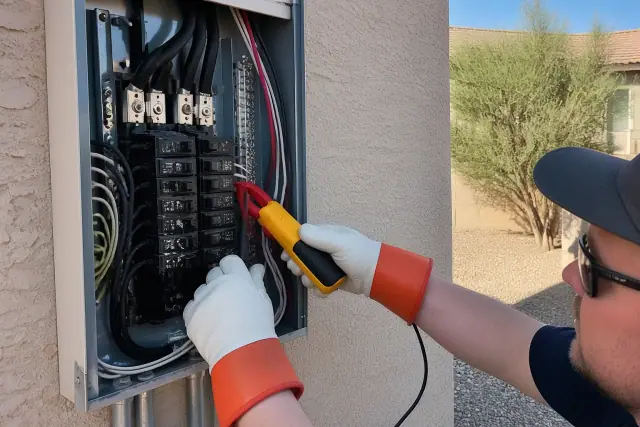
Electrician using a clamp meter to measure load on a residential service panel in Phoenix, AZ.

The main panel, existing breakers, and a documented load calculation. This helps explain why open physical space alone does not prove that the panel has electrical capacity.

Wall-Mount vs. Driveway Pedestal

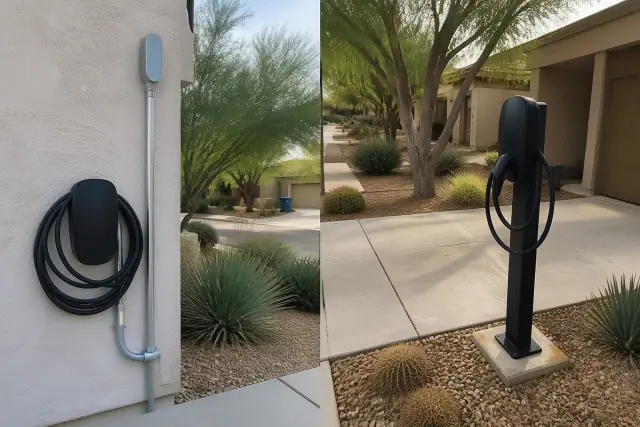
Wall-mounted EV charger with conduit installed on a stucco home exterior in a xeriscaped yard in Phoenix, AZ.

Compare a garage wall unit near a consistent parking spot with a pedestal for driveway or exposed parking. The view should make cable reach, mounting support, and vehicle position easy to evaluate.

Outdoor Conduit and Weatherproof Enclosure

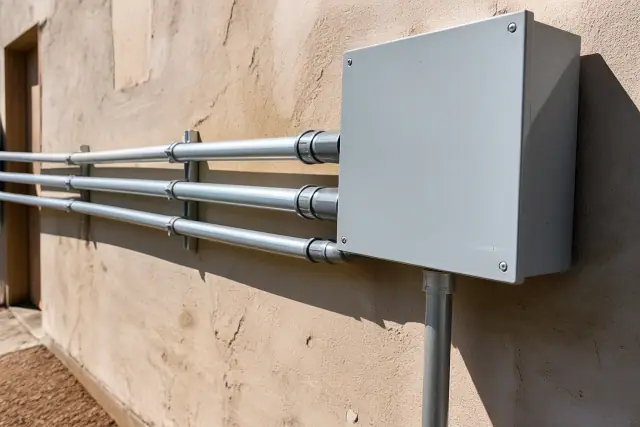
Metal conduit pipes and a weatherproof junction box on a stucco wall at an industrial jobsite in Phoenix, AZ.

A NEMA-rated outdoor enclosure and the protected conduit route to a pedestal. Phoenix equipment must be planned for summer temperatures above 110°F and monsoon downpours from July through September.

Charging and Project Snapshot

Level 1 Charging

A Level 1 charger uses a standard 120-volt outlet and adds roughly 3 to 5 miles of range per hour. That can suit plug-in hybrids or light daily driving.

Level 2 Charging

A Level 2 charger on a 240-volt, 40-amp circuit adds roughly 25 to 30 miles of range per hour. It is the common residential choice for daily EV use.

Standard Installation

Physical installation typically takes 2 to 3 hours once permits are ready. Inspection scheduling may add a few business days depending on the jurisdiction's queue.

Higher-Scope Work

A panel upgrade, trenching to a detached garage, or outdated wiring in a pre-1970s home takes longer. Older properties may also require added pre-installation inspection consideration.

Installation Planning Matrix

Installation ScenarioSource-Supported Range or RequirementWhat to Confirm
Suitable 240-volt outlet nearbyLabor may run $250 to $800.Outlet, circuit, charger, permit, and inspection compatibility.
Typical residential Level 2 projectTotal installation typically runs $800 to $3,000.Panel capacity, circuit distance, mounting location, and trenching.
Underground driveway pedestalConduit burial is 18 to 24 inches, depending on conduit type.Trench route, property lines, shared driveways, and easements.
Commercial multi-port stationAbout $300 to $35,000 per port.Number of ports, panel capacity, trenching, and infrastructure scope.

What This Means

Choose the charger only after matching daily driving needs to panel capacity, circuit distance, and parking location. Level 1 can cover lighter use, Level 2 is the typical residential upgrade, and Level 3 fast charging requires commercial-grade infrastructure rather than a residential installation. A panel assessment and site plan prevent buying equipment that the property cannot support or mount safely.

Factors That Change the Answer

The recommendation changes with existing household demand, main-breaker headroom, charger amperage, and the distance from the panel. Garage walls favor wall-mounted equipment, while driveways and carports may call for a pedestal, weatherproof enclosure, and underground conduit. A load management device can throttle charger amperage as household demand rises, sometimes avoiding a full service upgrade. Smart charging can also schedule use during off-peak utility hours, so rate plans and possible rebates are worth checking before equipment is finalized.

Common Follow-Up Questions

Can you upgrade charger amperage later? Often yes, if the initial circuit and conduit are sized for future capacity and the panel load calculation leaves enough room. Does an EV-ready garage help at resale? A properly permitted installation may be viewed as a useful convenience, while unpermitted electrical work can complicate disclosures. Can smart charging reduce operating cost? Scheduling for off-peak utility hours may lower the bill, depending on the available rate plan.
Plan Your Installation

Ready to Plan Your Installation?

Share the charger level, vehicle parking spot, panel information, and preferred mounting location. An assessment can confirm circuit capacity, permit needs, equipment placement, and whether load management or a panel upgrade belongs in the scope.